

Professor Wole Soyinka Visits Utopia Theatre’s The Swamp Dwellers in Sheffield
The Nobel laureate stepped into Dr Mojisola Kareem’s intimate staging of his own 1958 play, marking a rare moment of cultural continuity between writer, company, city and generation.
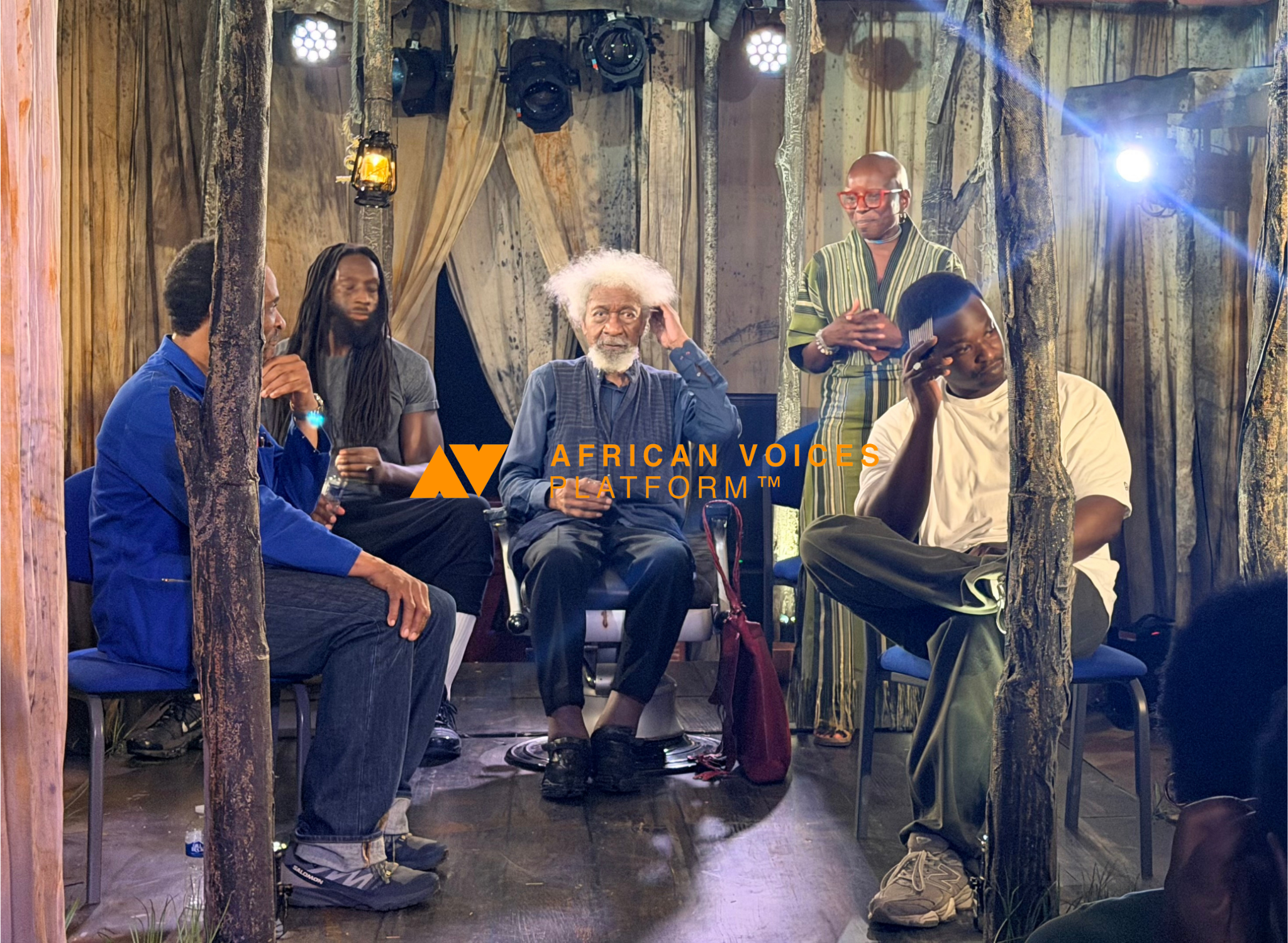
Professor Wole Soyinka seated on set ahead of a Q&A alongside cast and creatives from The Swamp Dwellers at Utopia Theatre, Sheffield, on 6 July 2026
Ahead of scheduled engagements with young people, a Sheffield school and community members, the Nobel laureate made a welcome visit to Dr Mojisola Kareem’s intimate staging of his own 1958 play.
Professor Wole Soyinka visited Utopia Theatre’s production of The Swamp Dwellers in Sheffield on Monday 6 July, stepping into the world of a play he wrote more than six decades ago.
Directed by Dr Mojisola Kareem, the production is running at Utopia Theatre from 29 June to 11 July. African Voices Platform, official media partner for the production, was present inside the room to document the visit.
Professor Soyinka was already in Sheffield ahead of scheduled engagements on Tuesday 7 July, including time with a Sheffield school and an engagement with young people and community members. His visit to the production on Monday evening was therefore a welcome and significant surprise, the writer entering the set, the room and the living atmosphere of the play before the wider public programme began.
The Swamp Dwellers is being staged for an audience of just 50 people per performance, with no distance built into the room. The set sits with the audience and holds them inside it. Viewers enter a world shaped by water, land, faith, family, migration, spiritual authority and the difficult cost of leaving or returning home.
Set among a Nigerian riverine community, the play turns on pressures that have not aged out of meaning. They were already there when Soyinka wrote the work in 1958, two years before Nigerian independence. Dr Kareem’s staging does not strain to update the text. It trusts it.
That trust is part of what gives this production its force. The production has also drawn national critical attention. In a four-star review, The Guardian described Utopia Theatre’s staging as “a total revelation”, noting the intensity of the 50-seat space and Dr Mojisola Kareem’s direction of a work that moves between family, spiritual authority, migration and environmental pressure.
In conversation with African Voices Platform ahead of the run, Dr Kareem spoke about the intentionality behind staging The Swamp Dwellers now. Her approach has been shaped by careful casting, a close attention to the world of the play, and a commitment to involving young people meaningfully in the production and its legacy.
Dr Kareem’s involvement of young people sits inside the production’s artistic logic. They are being brought close to the language, the process and the responsibility of carrying a major African text into the present. The work is not being kept at a distance. It is being picked up, inhabited and passed on by people who were not alive when it was first performed.
That is the frame through which Professor Soyinka’s visit should be understood and not a celebrity appearance. The tone of the visit was quiet, observational and unhurried. He moved through the production environment and entered the set itself, encountering in Sheffield a play he first wrote in Nigeria, now being carried by a director, company and audience in a different country and a different decade.

Professor Wole Soyinka outside Utopia Theatre, Sheffield, during his visit to The Swamp Dwellers, directed by Dr Mojisola Kareem, on 6 July 2026.
As writer, Soyinka entered the world of his own play and found it being carried by artists who had not inherited it passively. They had worked through its language, arguments, griefs and silences, returning them to the stage as a live exchange between generations.
The production also reaches beyond Sheffield through the swamp itself. In Soyinka’s play, land and water are not scenery. They shape labour, belief, movement, hunger and the pressure to leave. Today, as riverine and coastal communities confront flooding, extraction and displacement, the play’s environmental world feels less like history than warning.
Soyinka was seated with Teju Kareem, Executive Producer and Founder of the Wole Soyinka International Cultural Exchange , as cast, creatives and guests gathered in the space. WSICE’s presence placed the evening within a wider cultural frame of literature, arts, cultural exchange and intergenerational encounter.
African Voices Platform’s role in this partnership has been to stay close to the production as it has taken shape. Through conversations with Dr Mojisola Kareem and cast members including Jude Akuwudike, Urielle Klein-Mekongo, Theo Ogundipe, Joshua Roberts-Mensah and Obi Maduegbuna, AVP has followed the work from the rehearsal room into performance: the character choices, the language, the design, the questions of faith, power, migration and return.
Professor Soyinka’s visit now sits within that wider documentation. It brought the writer into the same room as the director, cast, young people connected to the production, and audiences encountering the play in Sheffield. The moment was understated, but clear in its meaning: The Swamp Dwellers is being handled as living work.
For AVP, that is the story to document - African theatre moving through people, rooms and generations, without losing its weight.
The Swamp Dwellers continues at Utopia Theatre, Sheffield, until 11 July, with an audience of just 50 people per performance.
Tickets: utopiatheatre.co.uk
Photos: African Voices Platform