

The Pacesetters: A card game that caught my curiosity but struggled to keep its momentum
An independent play-test review by Tchiyiwe Chihana | African Voices Platform
Holding the history of Oyo State in my hands was instantly appealing.
When I first opened The Pacesetters: Golden Jubilee Game & Quiz, I found myself studying the cards. I was reading the information, looking at the photographs and becoming curious about the places and aspects of Nigerian history they represented.
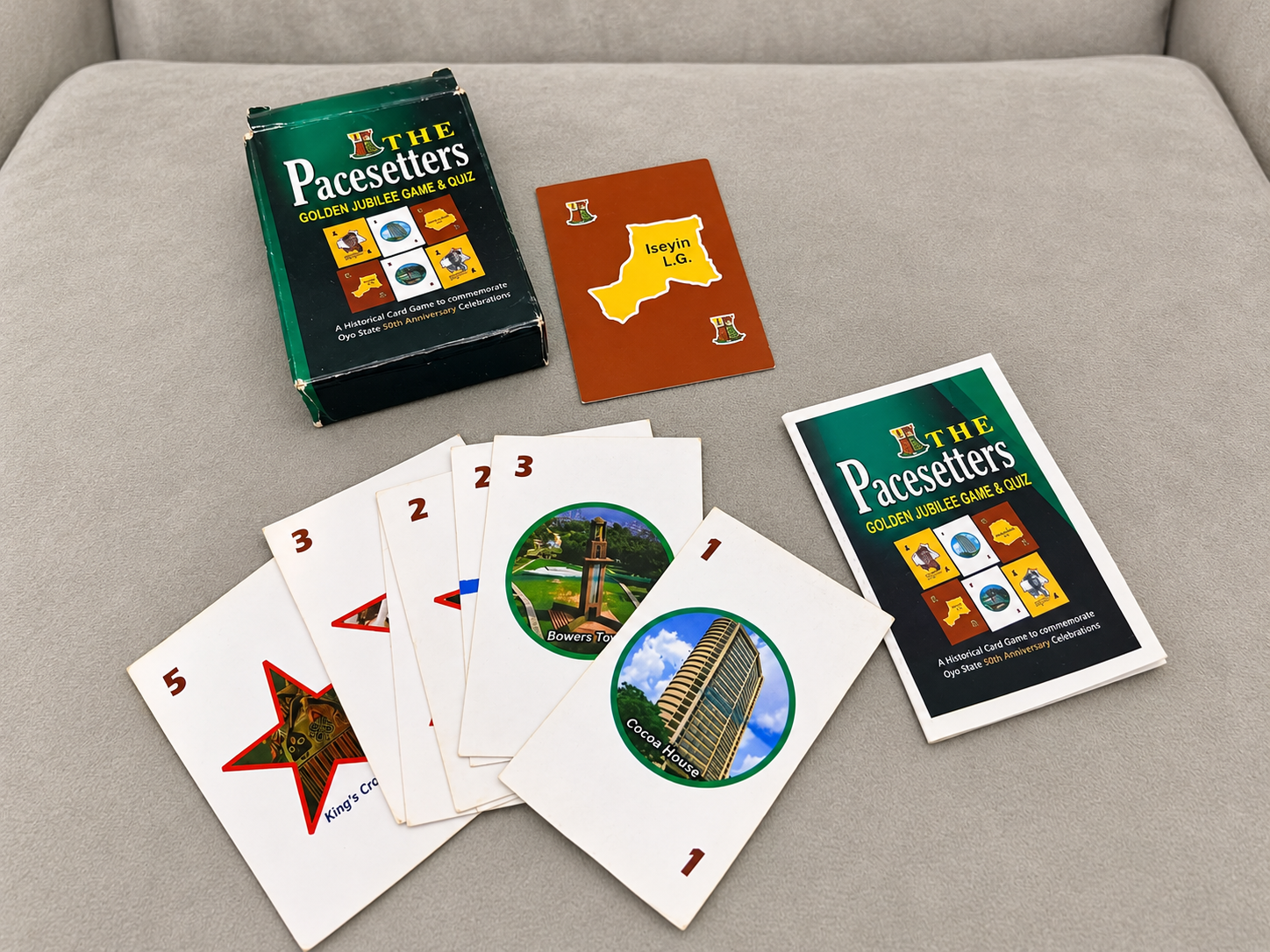
The Pacesetters cards laid out in my home
Created by Nigerian educational games designer Dr Olajide Aderinto to celebrate Oyo State’s golden jubilee, The Pacesetters brings together local geography, historical figures, landmarks and cultural heritage in a familiar card-game format.
It is an interesting proposition. How do you make history accessible beyond textbooks, museums and classrooms? Could an ordinary game of cards encourage people to discover more about the places and people whose histories they share?
Having interviewed Dr Aderinto for AfriWoman Chats, I wanted to experience the games he had developed for myself. He supplied copies for review, and I began with The Pacesetters.
First impressions: The history invites attention
The deck contains 52 cards, with numbered shapes used for a WHOT-style matching game and historical material presented on the other sides. The shapes have a geographical significance within the designer’s system: circles represent Ibadan, triangles Oke Ogun, crosses Ogbomoso, squares Ibarapa and stars Oyo.
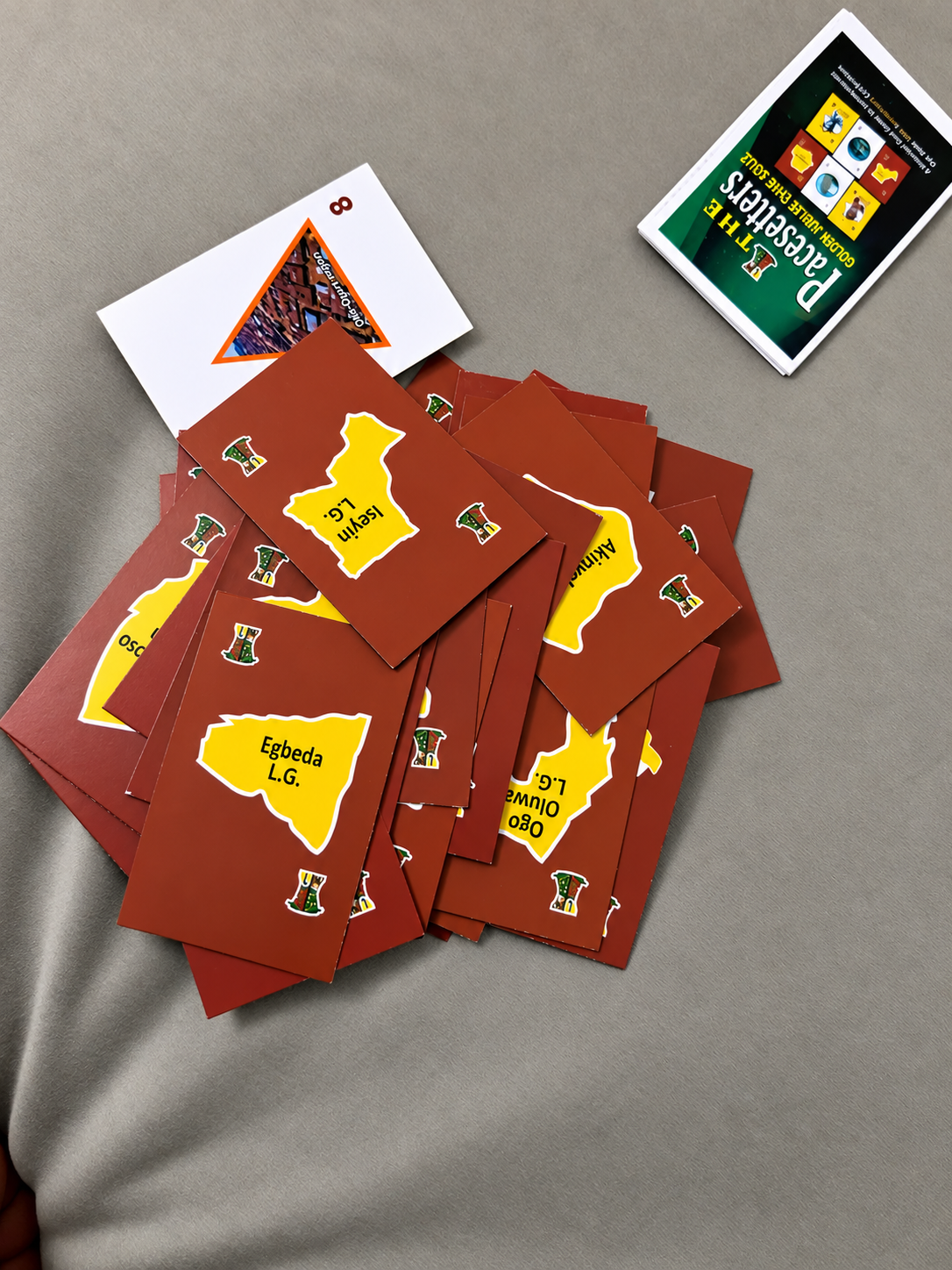
Physically counting the cards in the pack
This gives an otherwise familiar matching game a distinct local identity.
As I handled the cards, I encountered references to landmarks, educational institutions, agriculture and cultural practices. The inclusion of places such as Osuru Waterfall and LAUTECH gave me reasons to look beyond the numbers.
That initial experience matters.
For someone unfamiliar with Oyo State, the cards offer an introduction to a range of places and subjects they might otherwise never encounter. For those with connections to the region, there may be opportunities for recognition, conversation and shared memories.
I found myself reading the cards voluntarily, particularly at the beginning. That was one of the most encouraging aspects of the experience.
Playing the game: An intriguing beginning
For our first test, I played with the physical cards against an AVP Player hand, with the second player’s moves managed through a guided session and tracked throughout. We dealt five cards each, as permitted by the instructions.
The objective was straightforward: match the shape or number of the card on the discard pile and be the first to empty your hand.
Certain numbers introduce additional actions. A number 1 allows another turn, a 2 forces the next player to draw two cards and miss a turn, and a 5 requires them to draw three. An 8 can make the next player miss a turn.
These actions brought an immediate competitive element to the game.
In our opening sequence, AVP Player played several penalty cards in succession. My hand grew as I was repeatedly required to draw more cards and lose turns.
I described the experience at that stage as “intriguing”.
There was genuine anticipation in wondering what might happen next. The action cards disrupted the ordinary matching sequence and made the consequences of a move feel significant.
The first few turns showed how The Pacesetters can generate some of the suspense that makes traditional card games enjoyable.
When the game lost its rhythm
The difficulty emerged as play continued. I still wonder whether I hadn’t shuffled them sufficiently, though and carry that aspect consciously as I continue to think this through.
We eventually reached a Star 8 on the discard pile. Neither AVP Player nor I had a matching star, another number 8 or a wild card available. We began drawing. And drawing.
The same card remained on the table through successive turns, while both hands grew larger. I reshuffled the remaining draw pile, but the sequence of unsuccessful draws continued.
Eventually, I had 15 cards in my hand, compared with six held by AVP Player, and we still had not moved past the Star 8.
At that point, my response to the game had changed. “I’m finding it time consuming,” I said.
This was a significant shift from my initial curiosity and the adrenaline. The element of chance that had made the opening moves intriguing was now making progress difficult.
We ended the session without a winner.
A longer game is not necessarily a problem. Some of the most enjoyable games take time because they offer meaningful decisions, changing circumstances and opportunities for players to influence the outcome. Maybe if I had lots more time with less urgency to review, I would have breezed through the learning and played without looking back at the instructions.
In this instance, the repeated draws offered very little to decide or do.
It is important to qualify this observation. Our test involved my physical play and a the designated AVP Player, managed through the guided session. We also agreed a house rule that drawing a card ended the turn, even if the new card could be played. The printed instructions leave aspects of that procedure unclear. Our experience therefore cannot establish how every group or interpretation of the rules would perform.
Nevertheless, the prolonged stalemate was a real feature of this particular play-test, and it affected my enjoyment although my colleague was still up for it.
Does the history become part of the game?
This is perhaps my most important question about The Pacesetters. The historical content initially attracted my attention. I was interested in the photographs and the information presented on the cards. But as play became more competitive, I concentrated increasingly on the shapes and numbers.
That is what the matching game requires. I could play a card featuring a historical landmark without knowing anything about it. I could win a turn by matching a number without remembering the place shown on the card.
The cultural material was still present, but engagement with it depended largely on my curiosity.
This raises an interesting distinction between exposure to historical information and learning from it.
Seeing the name of a place might spark an interest in visiting it or discovering more. That is valuable. Yet recognising a landmark, remembering a fact about it and understanding its historical significance are different experiences.
The matching game did not require me to demonstrate those deeper levels of engagement.
There may be an opportunity to strengthen this connection. A simple mechanic encouraging players to identify a place, read a short caption or answer a question when certain cards are played could give the cultural material a more active role.
Of course, additional requirements would need careful design to avoid making an already slow game more cumbersome.
The instructions need greater precision
Our play-test also revealed several areas where the printed rules could be clearer.
We had to establish our own procedure for drawing cards. The instructions offer alternative effects for the number 8, while some other situations, including the precise penalty for failing to announce one’s last card, are insufficiently explained.
There is also a discrepancy in the contents list. The booklet describes a 52-card game, which matched my physical count, but the listed quantities of the different card types add up to 54.
These details may seem small, particularly to people accustomed to establishing their own house rules. However, clarity matters for a product intended to be played independently, especially if it is introduced in schools, community settings or intergenerational groups.
A revised instruction booklet, supported by a worked example of play, would make the game easier to approach consistently.
My assessment
I see real merit in the ambition behind The Pacesetters.
There is value in creating accessible cultural materials that invite people to encounter local history through everyday activities. The cards succeeded in catching my attention, and the early special-card moves created a sense of anticipation.
But the matching game did not sustain that momentum during our test and again, I wonder whether the shuffling was poor on my part.
Its educational content was more successful at prompting my initial curiosity than its mechanics were at keeping me engaged with that information throughout play.
I would like to see a clearer rulebook, greater attention to prolonged sequences of unsuccessful draws and more deliberate ways of bringing the historical content into the actual decisions players make.
These observations concern the WHOT-style matching game. The Pacesetters also includes a separate historical quiz, with its own questions and scoring system, which I have played and reviewing separately and provides a stronger opportunity for active learning.
For now, my experience leaves me with two impressions.
The first is that The Pacesetters contains historical and cultural material capable of generating genuine interest and enjoyed in any combination of socialisation
The second is that an educational game’s ability to attract curiosity is only part of its success. It must also sustain the experience that gives people an opportunity to learn.
That is where I believe The Pacesetters has room to develop.
Review disclosure: Dr Olajide Aderinto supplied the game for independent consideration following his appearance on African Voices Platform’s AfriWoman Chats. This review is based on examination of the supplied materials and a guided physical-card play-test, with the second hand designated AVP Player and its moves managed through the guided session. The matching game was not completed, and the separate historical quiz has been play-tested separately